
September 1, 2026
Your Whitby Customers Are Standing in the Driveway
A trade website that looks fine on a monitor can still fail the only moment that matters: a homeowner on a phone, outside, trying to call you before they call someone else.
Picture the person who is actually looking at your website
They are not at a desk. They are standing in their kitchen with a phone in one hand, looking at the thing that just broke, and typing something into Google with the other. Whatever your site looks like on a 27-inch monitor is irrelevant to that moment. What matters is what happens in the few seconds they give you on a screen the size of their palm.
That is the whole argument for building mobile-first, and it has nothing to do with design trends. It is about who is holding the device.
What "mobile-first" is not
It is not a desktop site that shrinks. Most template and page-builder sites technically work on a phone — the text reflows, nothing falls off the edge — and everybody involved calls that responsive and moves on. But shrinking a desktop layout is not the same as designing for the situation the phone is used in.
The tell is usually the phone number. On a lot of trade websites it sits in a header that collapses into a hamburger menu, so a homeowner who has already decided to call you has to tap the menu, scan a list of pages, find contact, tap again, wait for a page load, and then find the number. Every one of those taps is a place to give up and go back to the search results, where your competitor is one line down.
Build for the one thing they came to do
A homeowner searching for a tree service or an electrician is not browsing. They have one job, and it is to get hold of somebody. A site built around that job looks fairly plain:
- The phone number is visible without a tap, and tapping it starts the call.
- What you do and where you do it is readable in the first screenful, without pinching.
- The pages are light, because a phone on cell data in a driveway is not a fibre connection in an office.
That is roughly the shape of the site I built for Bourne To Climb, an owner-operated tree service here in Oshawa. One page, built for the phone, because that is where people look for a tree service. There is no 10-page "About Us" on it, because nobody with a branch on their roof has ever wanted one.
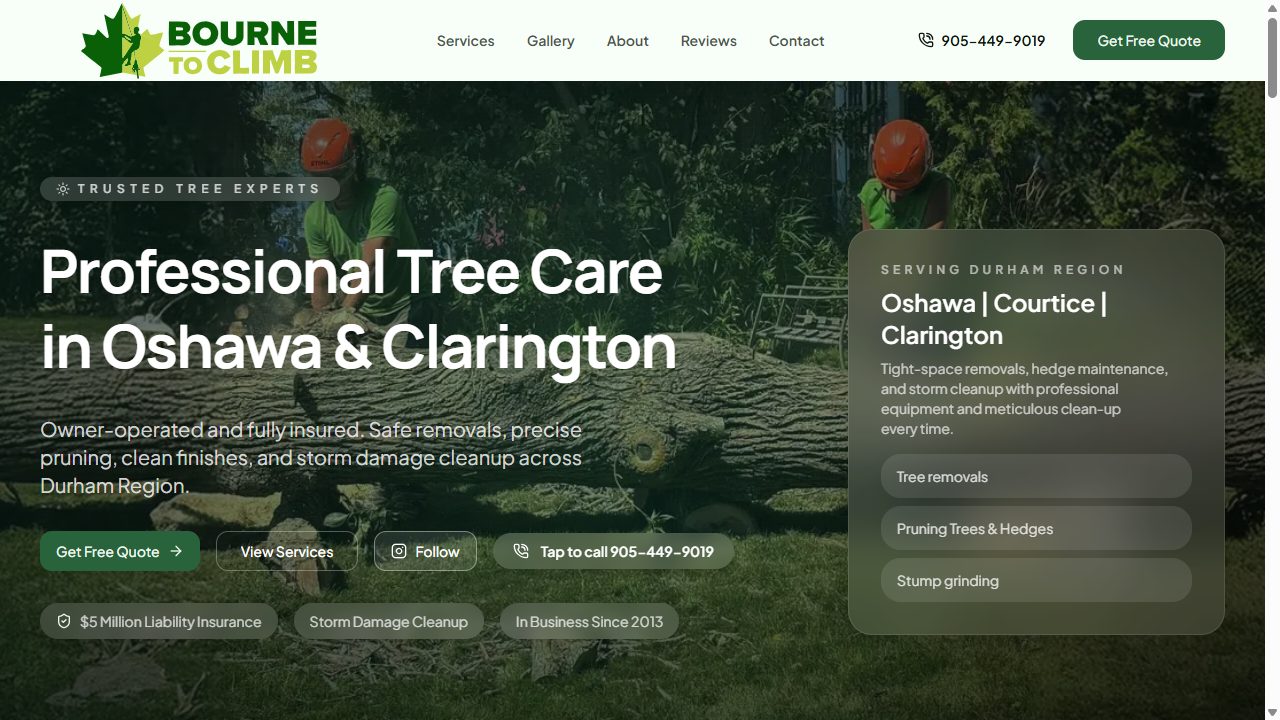
Everything a homeowner needs to act is in the first screenful — what the business does, the towns it covers, and two separate ways to start the call without hunting for a menu.
Where the weight comes from
The bloat is rarely something the business owner asked for. It arrives with the platform. A page builder ships a stack of scripts to make the drag-and-drop editing work, then a plugin for a contact form, another for a gallery, another for cookie consent, and each one adds to what a phone has to download before anything is readable. None of it is visible in the editor. All of it is felt in the driveway.
The way out is not a bigger website. It is a smaller one, built without the layer that made the weight in the first place.
What this actually costs you
The frustrating part is that the lost calls are invisible. Nobody fills in a form to tell you your site was too slow to bother with. There is no notification. The homeowner simply calls the next business on the list, and as far as your website is concerned, that visit never happened.
So the question worth asking is not whether your website looks fine. Open it on your own phone, on cell data, standing outside, and try to call yourself. Count the taps. If it took more than one, that is the fix — and it is a small one.
If your site is a template that never really got built for the phone, that is exactly the gap the $500 website package is meant to close: fixed scope, agreed in writing before anything changes, and live within five business days of content approval. It covers Oshawa, Whitby and the rest of Durham Region.