Walk down a MiniSBK grid and you are mostly looking at GP-2s. It is the bike the Canadian classes are built around, and if you are budgeting a season here, it is almost certainly the one you are budgeting for.
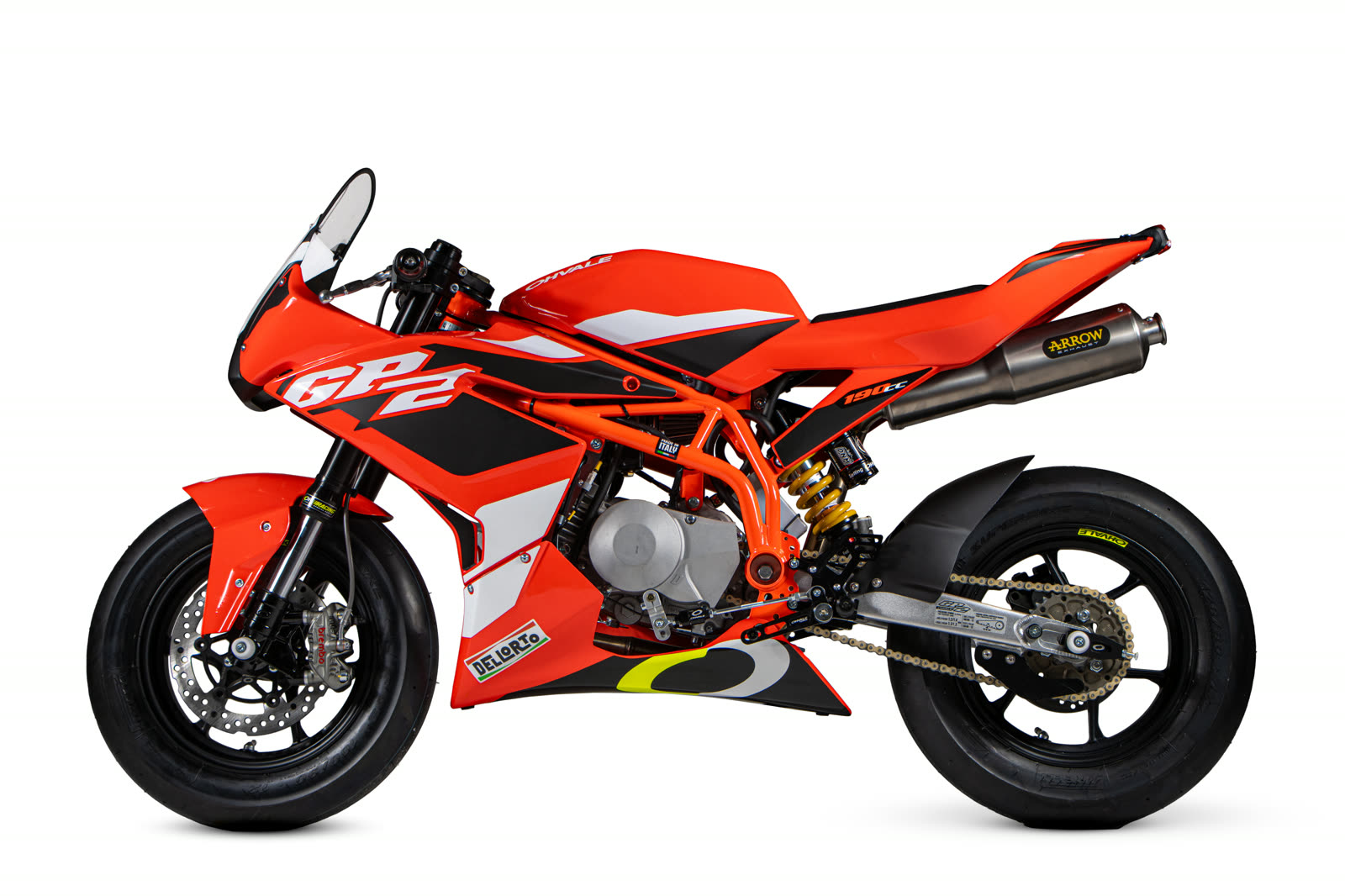
The headline difference from the GP-0 is the wheels: 12 inches instead of 10. That is the number everyone quotes. It is not the number that matters.
The measurement that actually changes things
Against the GP-0, the GP-2 is about 5.5 inches longer, 4.3 inches wider and 5 inches taller.
Read those three figures again, because they are the whole point of the bike. A kid does not outgrow a GP-0 because they have run out of power. They outgrow it because their knees are in their chin, they cannot get their elbows anywhere useful, and they have started riding around the bike instead of on it. You see it before they say it — the riding gets scrappy, the lap times plateau, and everybody starts hunting for a setup problem that is not there.
The GP-2 is the same idea as the GP-0 with room to grow into. Same Daytona 190 in the popular version, around 20 horsepower, four-speed box, 71 kilos on the scales. Steel-tube frame, unbraced aluminium swingarm, 12-inch cast wheels on Pirelli scooter rubber. Adults ride these, which is the clearest signal available about how much room is on board.
Why the class structure locks it in
MiniSBK and FIM MotoMini Canada run 160 and 190 classes. That is the ladder, and the GP-2 is the machine those classes are written around, which has a practical consequence worth understanding before you buy anything clever.
Whatever the merits of some other small bike, the grid you want to be on has a rulebook, and the rulebook has a shape. Buying outside it means either a class that does not exist here or a bike that gets to race in nothing. That is not Ohvale being dominant for its own sake — it is what happens when a national series standardises, and it is genuinely good for the racing, because it puts the difference back in the rider.
What it costs you in the garage
The GP-2 is a real race bike and it wants real maintenance — valve clearances, oil, chain, safety wire, all of it on a schedule. I have written about what that actually looks like on a Wednesday night, so I will not repeat it here beyond this: the running cost of a GP-2 is not the purchase price, and anybody who tells you a minimoto season is cheap is comparing it to the wrong thing.
The upgrade path is real too. Better forks are an off-the-shelf part rather than a fabrication job, which matters when a rider starts asking the front end questions it was not answering before.
The honest summary
The GP-2 is not exciting to write about, and that is exactly its virtue. It is the standard. It fits a kid from roughly the age they get serious until the point they are ready for something with grown-up wheels, it has a class to race in every weekend of the season, and the person next to you in the paddock has one too, which means somebody always has the part you just broke.
There is a reason the step up from the 160 to the 190 is the transition everyone talks about, rather than the step onto a different bike entirely. On this ladder, the GP-2 is the long middle.