At the top of the Ohvale range is a bike that has stopped pretending to be small.
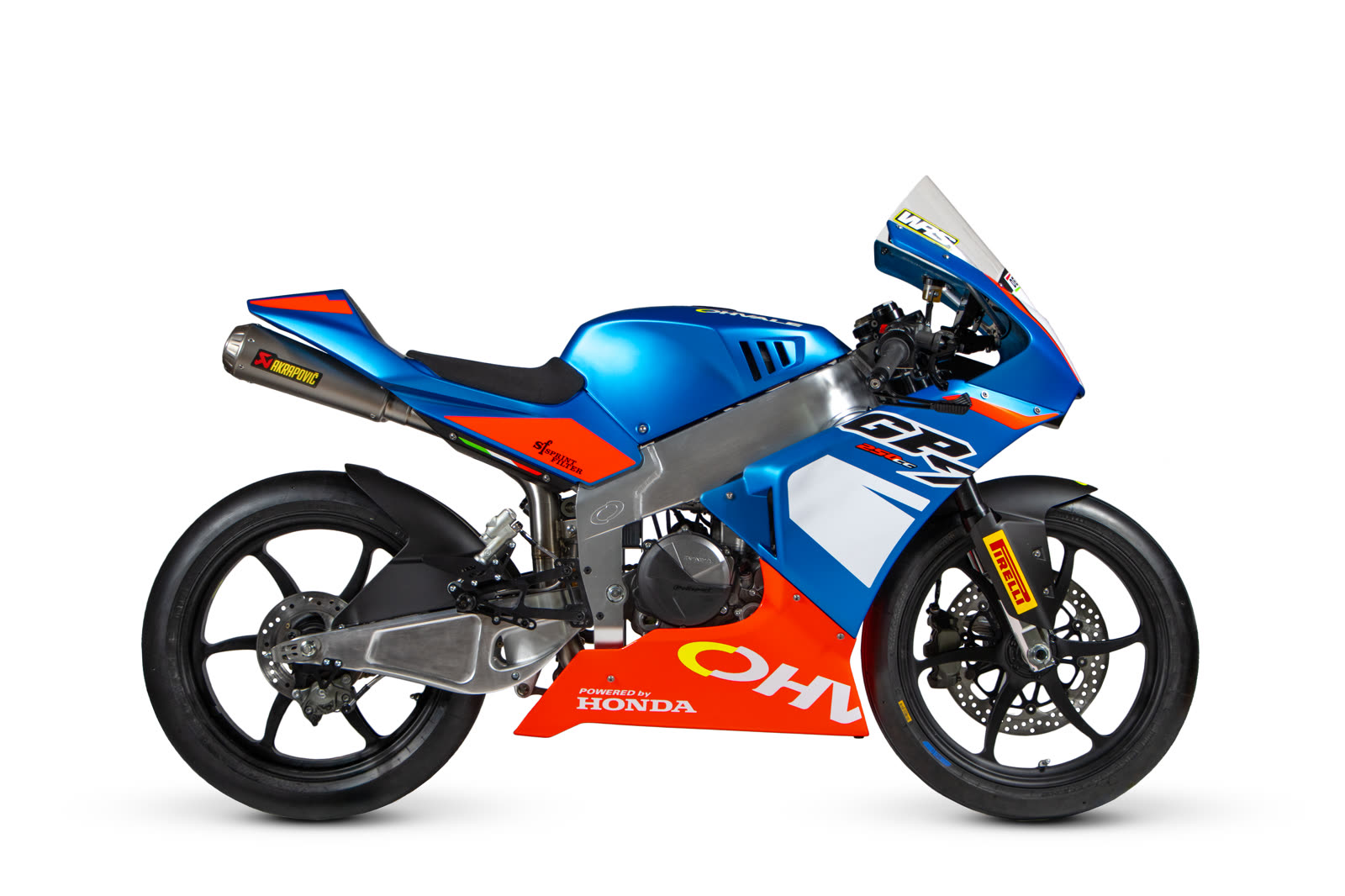
The GP-7 runs 17-inch wheels — 2.50 at the front, 3.50 at the rear. Those are full-size road racing dimensions. Whatever else this machine is, it is not a minimoto, and the spec sheet does not really let you argue otherwise.
Read the brakes first
The front end carries a Brembo M50 monobloc radial caliper, four 30 mm pistons, on a 300 mm floating disc. There is a 190 mm disc and a two-piston Brembo at the back.
An M50 on a 300 mm rotor is what you find on litre-class sportbikes. Putting that on a junior race bike is not showing off — it is an admission about what the bike is for. Stopping is the skill that scales worst as speeds rise, and a rider who has learned to trail-brake into a corner on equipment that gives them real feel does not have to unlearn anything later.
The rest of it
Two engine options, both single-cylinder four-stroke four-valve liquid-cooled 250s with Dell'Orto electronic injection: an RR250 built exclusively for Ohvale, or a Honda-powered version. Five speeds either way.
The chassis is an aluminium perimeter frame with an adjustable steering axle, and an aluminium swingarm whose stiffness can be adjusted. The Race version gets forged aluminium rims and an Öhlins TTX monoshock developed for the bike; the standard versions run a monoshock adjustable for compression, rebound, preload and length.
An adjustable steering axle and a swingarm you can tune the stiffness of are not features for a kid learning to ride. They are features for a team learning to set a bike up for a specific rider at a specific circuit. That tells you who Ohvale expects to be turning the spanners.
Ohvale points at the Italian GP Junior Championship and at Moto3-derived engine thinking when describing it, which is the clearest statement of intent available: this is the machine for a rider who is no longer developing, but competing, on a national junior stage.
Where it sits for us
This is the end of the Ohvale ladder, and it is worth being clear about what that means.
The GP-0 teaches a child to ride. The GP-2 is where they race for years. The new GP-5 exists to stop the jump from 12-inch wheels to full-size ones being a cliff. The GP-7 is what waits on the far side of that jump — and at that point the conversation is not really about mini road racing any more, it is about junior road racing on a purpose-built bike.
I have written before that the pathway into CSBK runs through small wheels, and that the small bikes force precision because there is no power to hide behind. The GP-7 is where that stops being true. There is enough bike here to cover for a rider, which is precisely why it belongs at the end of the ladder rather than anywhere near the start of it.
Whether a Canadian family ever needs one is a separate question, and it depends entirely on where a rider is going next. For most of the paddock, the honest answer is that the ladder here effectively tops out lower down, and the step after the 190 is a full-size production bike rather than an Italian junior GP machine.
Worth knowing it exists, though. It is the shape of what the ladder looks like when a country builds the whole thing.